Dengue Will ‘Take Off’ in Southern Europe, US, Africa This Decade, WHO Scientist Says

October 9, 2023

From MedScape

Dengue fever will become a major threat in the southern United States, southern Europe and new parts of Africa this decade, the WHO’s chief scientist said, as warmer temperatures create the conditions for the mosquitoes carrying the infection to spread.

Read more

AMCA Research Fund Day of Contributing: October 10, 2023

Date: Tuesday, October 10th, 2023

What Is It? It’s a day for everyone in the AMCA community to come together and support mosquito control research. Your contribution, no matter the amount, can make a significant impact.

How Can You Participate?

  1. Mark Your Calendar: Set a reminder for October 10th.
  2. Donate: We’ll provide a donation link on the day.
  3. Spread the Word: Share our social media posts to encourage your community to contribute too.

Why Do We Need Your Support? Your involvement can help us advance research, nurture young scientists, and protect public health. We are hoping our community can gather together to help us support one additional project each year!

Donate Today!

Convergent Trends and Spatiotemporal Patterns of Aedes-Borne Arboviruses in Mexico and Central America

Bernardo Gutierrez ,Darlan da Silva Candido,Sumali Bajaj,Abril Paulina Rodriguez Maldonado,Fabiola Garces Ayala,María de la Luz Torre Rodriguez,Adnan Araiza Rodriguez,Claudia Wong Arámbula,Ernesto Ramírez González,Irma López Martínez,José Alberto Díaz-Quiñónez,Mauricio Vázquez Pichardo,Sarah C. Hill, [ … ],Marina Escalera-Zamudio [ view all ]

Published: Plos Neglected Tropical Diseases, September 6, 2023

https://doi.org/10.1371/journal.pntd.0011169

Results indicate that CHIKV, DENV-1 and DENV-2 in Mexico share evolutionary and epidemiological trajectories. The southwest region of the country was determined to be the most likely location for viral introductions from abroad, with a subsequent spread into the Pacific coast towards the north of Mexico. Virus diffusion patterns observed across the country are likely driven by multiple factors, including mobility linked to human migration from Central towards North America. Considering Mexico’s geographic positioning displaying a high human mobility across borders, our results prompt the need to better understand the role of anthropogenic factors in the transmission dynamics of Aedes-borne arboviruses, particularly linked to land-based human migration.

Direct Mosquito Feedings on Dengue-2 Virus-Infected People Reveal Dynamics of Human Infectiousness

Louis Lambrechts, Robert C. Reiner et.al.

Plos Neglected Tropical Diseases Sept 2023

https://doi.org/10.1371/journal.pntd.0011593

This study in Iquitos, Peru, showed that dengue patients with mild disease were most infectious to Aedes aegypti mosquitoes 2 d after the onset of symptoms and that these mosquitoes were able to transmit their infection 7 – 16 d after blood feeding.  This empirical study provided a timeline for when secondary dengue cases could be expected following the onset of symptoms in an imported dengue case, thereby providing a timeline for preventive control operations.    

Article Series: Mosquitoes Are a Growing Public Health Threat, Reversing Years of Progress

September 29, 2023

From New York Times

Climate change and the rapid evolution of the insect have helped drive up malaria deaths and brought dengue and other mosquito-borne viruses to places that never had to worry about them.

Read more here

The late-summer itch: Ankle-biting mosquitoes are in extra full force in L.A. Why?

From LA Times

September 21, 2023

When you think “so L.A.,” Erewhon smoothies, Barbie-pink sunsets and baristas with IMDB credits might come to mind. Now you can add mosquitoes to the list.

Read more here


CA Endures Worst Mosquito Season In Years. When Will It End?

From Patch

September 16, 2023

As the blood-sucking ankle-biters take bite out of the Golden State, human West Nile Virus cases are spiking.

Read Here

The biting rate of Aedes aegypti and its variability: A systematic review(1970–2022).

:ZahidMH, VanWykH, MorrisonAC, ColomaJ, LeeGO, CevallosV, etal.(2023)

https://doi.org/10.1371/journal.pntd.0010831

Author summary: Half of the world’s population is now at risk of dengue infection, which transmits to humans mostly through the bite of an infected female Aedes aegypti mosquito. Disease transmission models have played an important role in understanding the dynamics of dengue transmission and helping to develop control measures. The mosquito biting rate is one of the central parameters used in these models. Mosquito biting rates used in existing works are taken from a variety of studies, each with its strengths and limitations. To understand how existing study designs are used to estimate biting rate and how these estimates may vary over time, space, and environmental factors, we perform a systematic review of biting rate studies. We identify three study designs (human landing catch, marked-release-recapture, and histological) that play an important role in estimating per mosquito biting rates and capturing variability across a number of environmental factors. In particular, human landing catch studies can capture the variability of biting rates and marked-released-recapture studies along with histological studies can quantify the multiple feeding that occurs between ovipositions. Transmission modeling studies should be more informed by the biology of mosquito behavior. By understanding the biology of blood-feeding and context-specific factors, we can arrive at more informed per mosquito biting rate estimates for site-specific transmission model analysis.

[Submitted by the Vector and Vector-Borne Disease Committee]

West Nile virus is a growing threat this summer in California. What you need to know

August 30, 2023

From Los Angeles Times

West Nile virus infections are on the rise this year in California after a particularly wet winter led to more mosquito reproduction, according to health experts.

Read More

In the US, West Nile virus is leading cause of viral disease spread by insects, CDC study says

August 24, 2023

From CNN

The United States has seen a flurry of West Nile virus deaths reported in the last few days, including most recently in Illinois, Nebraska and Colorado.

Read More 

Community-based Integrated Tick Management Programs: Cost and Feasibility Scenarios

TL Schulze, L Eisen, K Russell, RA Jordan
Journal of Medical Entomology, tjad093, https://doi.org/10.1093/jme/tjad093
 
Abstract: Numerous studies have assessed the efficacy of environmentally based control methods to suppress populations of the blacklegged tick (Ixodes scapularis Say), but few of these estimated the cost of control. We estimated costs for a range of tick control methods (including habitat management, deer exclusion or population reduction, broadcast of acaricides, and use of host-targeted acaricides) implemented singly or in combination and applied to a model community comprising 320 residential properties and parklands. Using the high end for cost ranges, tick control based on a single method was estimated to have mean annual costs per household ranging from $132 for treating only forest ecotone with a broadcast synthetic acaricide to kill host-seeking ticks (or $404 for treating all residential forested habitat) to >$2,000 for deployment of bait boxes (SELECT TCS) across all residential tick habitat to treat rodents topically with acaricide to kill infesting ticks. Combining different sets of multiple methods in an integrated tick management program placed the annual cost between $508 and 3,192 annually per household, underscoring the disconnect between what people in Lyme disease endemic areas say they are willing to pay for tick control (not more than $100–150 annually) and the actual costs for tick control. Additional barriers to implementing community-based tick management programs within residential communities are discussed.
 
Notes: Surveillance and determination of pathogen risk provide a basis for public health messaging to warn the public in affected areas, but do little to actually mitigate the problem. As risk elevates so does the mandate for a coordinated response. Schulze et al. provide estimates of mitigation costs to residents residing within Lyme disease endemic areas in the Eastern USA. These data are useful for MVCAC agencies considering mitigation in response to increasing threats of tick-borne diseases. 
 
[Submitted by the Vector and Vector-Borne Disease Committee]


Delftia Tsuruhatensis TC1 Symbiont Suppresses Malaria Transmission by Anopheline Mosquitoes

Huang, W., J. Rodrigues, E. Bilgo, J. R. Tormo, J. D. Challenger, C. De Cozar-Gallardo, I. Pérez-Victoria, F. Reyes, P. Castañeda-Casado, E. J. Gnambani, D. F. Hien, M. Konkobo, B. Urones, I. Coppens, A. Mendoza-Losana, L. Ballell, A. Diabate, T. S. Churcher, and M. Jacobs-Lorena. 2023. delftia tsuruhatensis TC1 symbiont suppresses malaria transmission by Anopheline Mosquitoes. Science. 381: 533–540. DOI: https://doi.org/10.1126/science.adf8141
 
Abstract: Malaria control demands the development of a wide range of complementary strategies. We describe the properties of a naturally occurring, non–genetically modified symbiotic bacterium, Delftia tsuruhatensis TC1, which was isolated from mosquitoes incapable of sustaining the development of Plasmodium falciparum parasites. D. tsuruhatensis TC1 inhibits early stages of Plasmodium development and subsequent transmission by the Anopheles mosquito through secretion of a small-molecule inhibitor. We have identified this inhibitor to be the hydrophobic molecule harmane. We also found that, on mosquito contact, harmane penetrates the cuticle, inhibiting Plasmodium development. D. tsuruhatensis TC1 stably populates the mosquito gut, does not impose a fitness cost on the mosquito, and inhibits Plasmodium development for the mosquito’s life. Contained field studies in Burkina Faso and modeling showed that D. tsuruhatensis TC1 has the potential to complement mosquito-targeted malaria transmission control.
 
Notes: This article describes the findings of a study investigating the role of harmane, a compound secreted by Delftia tsuruhatensis TC1 bacteria, in the disruption of Plasmodium development in the midgut and the reduction of sporozoite prevalence in salivary glands of anopheline mosquitoes. The authors also describe the efficacious delivery of D. tsuruhatensis TC1 to larvae and adult mosquitoes in laboratory and field settings, indicating the versatility of potential deployment in the field.  Studies like this show the importance of understanding the mosquito microbiome in variability seen in pathogen transmission in the laboratory and field. 
 
[submitted by the Vector and Vector-Borne Disease Committee]


Near Tulare Lake, State Disaster Relief Includes Millions for Mosquito Abatement

From KVPR

August 7, 2023

One mosquito abatement district in Tulare County has reportedly purchased its first-ever drone, amphibious vehicle and airboat.

Read More

Fleaborne Typhus–Associated Deaths

Los Angeles County, California, 2022

Alarcón J, Sanosyan A, Contreras ZA, et al. MMWR Morb Mortal Wkly Rep 2023;72:838–843. DOI: http://dx.doi.org/10.15585/mmwr.mm7231a1
 
Abstract. Fleaborne typhus (also known as murine typhus), a widely distributed vectorborne zoonosis caused by Rickettsia typhi, is a moderately severe, but infrequently fatal illness; among patients who receive doxycycline, the case-fatality rate is <1%. Fleaborne typhus is a mandated reportable condition in California. Reported fleaborne typhus cases in Los Angeles County have been increasing since 2010, with the highest number (171) reported during 2022. During June–October 2022, Los Angeles County Department of Public Health learned of three fleaborne typhus–associated deaths. This report describes the clinical presentation, illness course, and methods used to diagnose fleaborne typhus in these three cases. Increased health care provider and public health awareness of the prevalence and severity of fleaborne typhus and of the importance of early doxycycline therapy is essential for prevention and treaogy oftment efforts.
Comment.  For detailed accounts on the evolution and extent of this problem in Los Angeles and Orange Counties see Cummings et al. (2022: PMVCAC 90: 33-42).  As reviewed, the epidemiology and etiology of typhus has been somewhat confounded by the occurrence of two rickettsia with differing life cycles and transmission patterns. However, the expansion of urban rodent, opossum and feral cat populations clearly have exacerbated the problem. The spread of homeless encampments is a related issue. Clinical research is needed to identify which rickettsia are involved in human disease, to delineate the extent of human infection in California, and to identify risk factors that may be targets for public health/vector control district intervention. Although human cases mostly seem confined to southern California, Rickettsia felis most likely is present wherever cat flea populations are found.  
 
[Submitted by the Vector and Vectorborne Disease Committee]    
 

Statement on Locally Acquired Malaria Cases in Florida and Texas

August 1, 2023

Recently, locally acquired cases of malaria in Florida and Texas have received national media attention. MVCAC has developed the below statement for member agencies to use when responding to questions regarding these detections and the risk of locally acquired cases in California. MVCDs are encouraged to tailor this statement with information specific to their district.

Despite reports of recent malaria cases in Florida and Texas, local transmission of malaria in the U.S. is very rare. Most malaria cases are acquired when people travel outside of the U.S. where malaria transmission occurs. Anopheles mosquitoes that can spread malaria are present in California, but the parasites that cause malaria are not currently found in these mosquitoes in California. The last cases of local transmission of malaria in California were reported in 1990. About 100 cases of malaria are reported each year in California from people who were infected while traveling in other countries. Since malaria is a reportable disease, all diagnosed imported cases are tracked by the state and local public health departments. The patient’s history and potential for exposure to local malaria vectors are evaluated and if need be, actions are made to prevent possible transmission within the local community.

Mosquito and vector control agencies in California monitor many species of mosquitoes including those that carry West Nile Virus, invasive mosquitoes, and those that have the ability to carry malaria. Mosquito and vector control agencies do this to protect public health and quickly respond when mosquito-borne diseases threaten residents.

Residents are encouraged to wear EPA-registered insect repellent and dump and drain all standing water in and around their homes to prevent mosquito bites. To learn more about mosquito prevention please visit mvcac.org. To learn more about malaria please visit the CDC and the California Department of Public Health.

West Nile Virus Strikes Again: Mosquito Spraying Ramps Up in San Jose, Milpitas

From Hoodline

August 1, 2023

In response to the discovery of West Nile virus-positive mosquitoes in San Jose and Milpitas, the Santa Clara County Vector Control District has initiated truck-mounted insecticide treatments to control and kill adult mosquitoes in the affected areas. 


Read more

Dangerous virus detected in mosquitoes in New Hampshire

From WMUR9

July 26, 2023

Health officials urge residents to take precautions. The mosquito-borne Jamestown Canyon virus has been detected in seven batches of mosquitoes in New Hampshire this year but has so far not been found in people.

Read more

New Process for Submitting Updated NOIs and PAPs to the State Water Board

June 2023

For vector control districts that wish to use pyriproxyfen in WOTUS, an updated Notice of Intent form and Pesticide Application Plan needs to be submitted to the State Water Board. Examples of completed documents can be found on the Water Board NPDES Vector Control Permit website. Due to web accessibility requirements, the State Water Board is no longer allowed to post 3rd party documents unless they are ADA-compliant. Therefore, the Water Board requests applicants post documents on their webpage and provide a link which will then be used to post on the State Water Board website for 30-day public comment as required per the permit.

Email Gurgagn Chand, Gurgagn.Chand@waterboards.ca.gov, your website link for the document. After the application link is posted for 30-day public comment, Water Board staff will notify you of any items that need to be addressed within the amended application package as well as any public comments received. If everything checks out, generally an amended Notice of Applicability approving the revisions will be issued by the Deputy Director of Water Quality within 1-2 weeks. 

Email MVCAC Regulatory Affairs Committee Chair (Erika Castillo, erika@mosquitoes.org) if you have any additional questions.

Locally Acquired Cases of Malaria in Florida and Texas

Click here to read

Summary:  CDC is collaborating with two state health departments on an investigation of six locally acquired cases of Plasmodium vivax malaria in Sarasota County, FL and one case in Cameron County, TX. There is no evidence to suggest that the cases in the two states are related. All patients were promptly treated at area hospitals and are recovering.

Most malaria cases diagnosed in the United States are imported, usually by persons who travel to countries where malaria is endemic. However, locally acquired mosquito-transmitted malaria cases can occur, as Anopheles mosquito vectors exist throughout the United States. In 2003, for example, there were 8 cases of locally acquired P. vivax malaria identified in Palm Beach County, FL.

Note: These vivax cases were travel related, but the source of the initial infection was not indicated. Possibilities include tourists visiting malaria endemic countries or immigrants with active parasitemia or relapsed chronic liver infections. The last outbreak of locally transmitted malaria in California occurred among farm workers in San Diego County during 1988 with Anopheles hermsi as the reputed vector

[https://www.cdc.gov/mmwr/preview/mmwrhtml/00001559.htm]. These events serve to remind us that we have vectors of travel related pathogens other than invasive Aedes.  

[Submitted by the Vector and Vector-borne Disease committee]

Field Evaluation of In2Care Mosquito Traps to Control Aedes aegypti and Aedes albopictus (Diptera: Culicidae) in Hawai’i Island.

KK Brisco, CM Jacobsen, S Seok, X Wang, Y Lee, OS Akbari, AJ Cornel

J Med Entomol 60: 364–372, https://doi.org/10.1093/jme/tjad005

Abstract [condensed]: Our In2Care trial was performed in the coastal settlement of Miloli’i in the southwest of Big Island where both Ae. aegypti and Ae. albopictus are found. This trial from Jul – Oct 2019 fell within the traditional wet season. No significant reduction in egg or adult counts were observed following 12 wk of two In2Care trap placements per participating household. In fact, an increase in adults during the trial required the local mosquito abatement program to stop the In2Care trap trial and institute a thorough source reduction and treatment campaign. The source reduction campaign revealed that a large variety and quantity of water sources competed with the oviposition cups that we had placed, which likely lowered the chances of our oviposition cups being visited by pyriproxyfen-contaminated Aedes adults exiting the In2Care traps.

Note: This report indicates that abundant alternative oviposition sites can compromise control that focuses on oviposition behavior. 

[submitted by the Vector and VectorBorne Disease committee].  

Mosquito Samples in Tulare County Test Positive for West Nile Virus

From ABC 50 Action News

May 26, 2023

Officials are asking residents to use insect repellent with DEET, wear long sleeves outdoors and drain any standing water.

Read more

Vector-Borne Bacterial Diseases: a Neglected Field of Infection Diseases Research

Laroche, M. and Weeks, E.N.I.

University of Texas, Galveston, TX and University of Florida, Gainseville.

Med. Vet. Entomol. 2023: 37: 177-178. DOI: 10.1111/mve.12646

Summary [VVBD Committee]: This short but interesting editorial reviews the bacteria transmitted by arthropods and concludes that although the burden of bacterial arthropod-borne bacterial diseases remains lower than the joint burden of parasitic and viral arthropod-borne diseases, there is an undeniable need to study these neglected pathogens. Significant gaps in their ecology, transmission pathogenesis still need to be filled.

Assessing the Influence of Climate on the Spatial Pattern of West Nile Virus Incidence in the United States

Morgan E. Gorris*, James T. Randerson, Shane R. Coffield, Kathleen K. Treseder, Charles S. Zender,

Chonggang Xu, and Carrie A. Manore


Environmental Health Perspectives 2023. Vol. 131, No 4. https://doi.org/10.1289/EHP10986

*Author email:  mgorris@lanl.gov

Summary [by Vector and Vector-borne Disease committee]: Using human case report data from 2005 to 2019 and seasonally averaged climate variables, the authors developed a predictive module to estimate mean annual WNV incidence. They found that regions with dry and cold winters and wet and mild summers have higher WNV incidence rates. Among the climate variables considered, winter precipitation, fall precipitation, and winter temperature were the three most important predictive variables. The authors believe this model may be a tool to predict the future spatial extent of WNV risk related to climate change. They acknowledged that subregional patterns of WNV are likely to be strongly influenced by a series of environmental variables such as land use, vegetation coverage, and hydrology. Dry agriculture landscapes that require significant irrigation also will influence patterns of WNV incidence.


How drones in South Bay are combatting an expected heightened mosquito season

From ABC7
May 3, 2023

For the first time, drone technology is taking off to combat mosquitos in the South Bay after an unprecedented rainy winter.

Mosquito season just started and this week the Santa Clara Vector Control District will begin using drones to reduce the mosquito population.

Nayer Zahiri, the county’s Vector Control District manager, said other districts in the state are using it.

“As you see a lot of standing water, a lot of waters around and we want to make sure we are able to control the stages we can control before they become adults,” Zahiri said.

Read more

Fight the Bite: County to Drop Mosquito Larvicide in Local Waterways Next Week

From Times of San Diego
April 20, 2023

San Diego County will conduct its first larvicide drop of the year on up to 51 local waterways as part of a campaign to combat diseases spread by mosquitoes such as West Nile virus, it was announced Wednesday.

Aerial larvicide drops are carried out once a month between April and October each year, covering around 1,300 acres of mosquito breeding areas.

The routine helicopter drops will be conducted next Wednesday, and Thursday if necessary, according to a news release from the county.

County officials say the larvicide does not hurt people or pets.

Read more

Epidemic versus endemic West Nile virus dead bird surveillance in California: Changes in sensitivity and focus.

Posted by Vector and Vector-borne Disease Committee
April 19, 2023

Leslie Foss*, Tina Feiszli, Vicki L. Kramer, William K. Reisen, Kerry Padgett.

*Leslie.Foss@cdph.ca.gov

PLoS ONE April 6, 2023 https://doi.org/10.1371/journal.pone.0284039

Abstract [condensed]

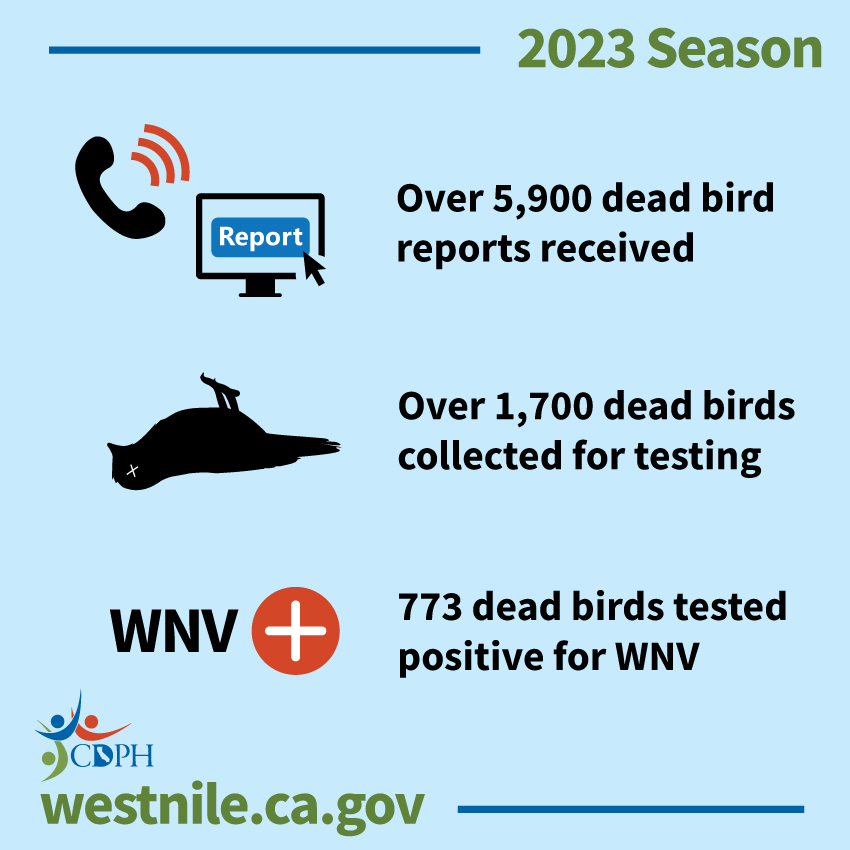
Since 2003, the California West Nile virus (WNV) dead bird surveillance program (DBSP) has monitored publicly reported dead birds for WNV surveillance and response. We examined DBSP data from the early epidemic years (2004–2006) with recent endemic years (2018–2020) to characterize changes in program operations, patterns of dead bird reports, and WNV prevalence among dead birds and their utility as early indicators of WNV activity. In recent years fewer agencies collected dead birds for testing, but updated protocols enhanced the efficiency of the program. The number of dead bird reports was approximately ten times lower during 2018–2020 compared to 2004–2006; reports from the Central Valley and parts of Southern California decreased the most. Dead corvid, sparrow, and quail reports decreased the most compared to other bird species reports. In the early years, WNV positive dead birds were the most frequent first indicators of WNV activity; in contrast, during 2018–2020 mosquitoes were the most frequent first indicators. Evidence for WNV impacts on avian populations and susceptibility are also discussed.

Note: Despite declines in the number of birds reported by the public, dead bird surveillance remains important to better understand changes in WNV ecology and adds critical data to a comprehensive environmental surveillance program.

This mosquito season could be worse than before after SoCal’s historic rainfall

From ABC 7
April 12, 2023

ORANGE COUNTY (KABC) — Southern California is still a couple months away from mosquito season, but this season could potentially be one of the worst because of all the rain to start the year.

However, the Orange County Mosquito and Vector Control District is being proactive.

Heather Hyland, director of communications for OC Vector, said spots that didn’t have standing water before may have some now.

“There’s areas due to the rain that are filling up that are producing more egg laying sites for mosquitos per usual,” Hyland said.

She said they’re seeing more mosquitoes in traps laid out to monitor their population.

Read more

Mosquito Awareness Week

Mosquito Awareness Week, observed April 16 – 22, 2023, educates California residents about mosquitoes and how to help prevent the spread of mosquito-transmitted diseases

Press Release

Social Media Graphics:


Invasive Aedes Toolkit

This invasive Aedes toolkit is designed to assist MVCAC members in their public education and outreach efforts.

Communities with Invasive AedesCommunities without Invasive Aedes

Communities without Invasive Aedes

A systematic review of published literature on mosquito control action thresholds across the world

Posted by Vector and Vector-borne Disease Committee
April 5, 2023

Vindhya S. Aryaprema, Madeline R. Steck, Steven T. Peper, Rui-de Xue, Whitney A. Qualls*

*wqualls@amcdfl.org

PLoS Neglected Tropical Diseases 2023.  https://doi.org/10.1371/journal.pntd.0011173

Condensed abstract.   Many different methods are used and new methods are evolving to control nuisance and vector mosquito populations across the world. Implementation of such control methods at the optimal time has been identified as critical to maintaining the populations below unacceptable levels. The establishment of evidenced-based action thresholds is encouraged to achieve maximum results under available resources. This review identified 87 publications: 30 reported originally generated thresholds, 13 inclusions reported a statistical method with a computable action threshold model, and 44 inclusions mentioned only previously generated thresholds. Overall, the inclusions with thresholds that were directly related to disease transmission conditions (“epidemiological thresholds”) outnumbered the inclusions with thresholds that were directly related to mosquito abundance (“entomological thresholds”). The majority of the thresholds originated in Asia targeting dengue and dengue vectors. The review discusses the associated surveillance characteristics such as the possibility of using external data (previously recorded data), spatial and temporal variations in data, and the importance of an adequate lead time to initiate control interventions that would help guide to plan better surveillance programs for the development of action thresholds.

Note:  Paper could provide useful references for decisions on the control of invasive Aedes. 

Will SoCal see more mosquitoes after all this rain? Officials urge residents to prepare now

From ABC7
March 29, 2023

DUARTE, Calif. (KABC) — With so much rain drenching Southern California this season, there is another pesky problem lurking around the corner: mosquitoes.

“It doesn’t take long for mosquitoes to go from the larva you see to full grown ones that’ll look for someone like you to sting,” said Pablo Cabrera with the San Gabriel Valley Mosquito & Vector Control District.

Dense vegetation and stagnant water allow mosquitoes to grow and hide. Just a small amount of water is all mosquito needs to lay their eggs and with the historic rainfall, residents are being asked to do three things: tip, toss and protect.

The San Gabriel Valley Vector Control District urges resident to tip out stagnant water weekly, toss any unused containers left outside that can collect stagnant water, and protect yourself with some sort of mosquito repellent.

Cabrera said the SGVMVCD hasn’t captured any adult mosquitoes at the moment, but once the dry, warmer weather hits, that will change.

Read more


‘Big concern’: Unusual mosquito season may be coming to California

From the San Francisco Gate
March 26, 2023

SACRAMENTO COUNTY, Calif. — It is that time of year: Mosquitoes are back.

The bad news? You’ll likely see more of them this season, and with more mosquitoes comes a higher risk of West Nile virus. The Sacramento-Yolo Mosquito and Vector Control District says the ongoing wet winter storms across the region since New Year’s Eve weekend are to blame.

“I think the amount of water we’ve seen over the last month or so is definitely a big concern,” Gary Goodman, the district manager, told KCRA 3.

Read more

Health Experts Warn of Mosquitoes in Standing Water Following Recent Storms

From NBC Bay Area
March 24, 2023

As we just hit spring, experts say mosquitoes are already multiplying, taking advantage of all the recent flooding.

In Belmont, families can still see and smell the flood waters that have been inundating them all year.

The conditions and all the standing water found around the bay area are a concern for The San Mateo County Vector Control Department who said, they’ve had more mosquito related requests than usual in the past few months.

In a statement. they wrote they anticipate water will continue to stand in many locations into the warmer month, so their acting now, regularly checking 40,000 sites throughout the county to prevent a large mosquito population and the viruses that come with them.

The county added they’re also working closely with communities prone to flooding by checking their crawlspaces something they recommend all families should do in case of any standing water.

Read more

2023 International Branch Virtual Symposium Program Now Available

Posted by Vector and Vector-borne Disease Committee
March 22, 2023

The online program for the 2023 International Branch Virtual Symposium now available! Check out the program and start planning your schedule. Plus, register now for FREE! Registration is free for ESA members and non-members alike. Spread the word and build excitement for insect science. Register nowreview the program, and learn more about the plenary speakers below.

April 24: Climate Change and Its Impact on Biological Control April 25: Endangered Species, Diversity/Taxonomy, Pest Management, and Social Insects April 26: Virus Vector Interaction

Note:  The program is only available after registration for non-members.  

Why Sacramento Valley experts believe you will see (and feel) more mosquitoes this season

From KCRA 3
March 22, 2023

It is that time of year in the Sacramento Valley: mosquitoes are back.

The bad news? You’ll likely see more of them this season, and with more mosquitoes comes a higher risk of West Nile virus.

The Sacramento-Yolo Mosquito and Vector Control District says the ongoing wet winter storms across the region since New Year’s Eve weekend are to blame.

“I think the amount of water we’ve seen over the last month or so is definitely a big concern,” Gary Goodman, the district manager, told KCRA 3.

He says standing water is the issue, especially in many places that haven’t seen a lot of water over recent years due to the drought, and believes we will have higher mosquito populations by the summer.

“We are anticipating a much busier year from an abundance standpoint and a [West Nile] virus standpoint,” Goodman said.

The main places of concern are agricultural areas and around rivers, creeks, and streams.

Read more

Kretschmer M, Collins J, Dale AP, et al. Notes From the Field: First Evidence of Locally Acquired Dengue Virus Infection — Maricopa County, Arizona, November 2022

Posted by Vector and Vector-borne Disease Committee
March 20, 2023

MMWR Morb Mortal Wkly Rep 2023;72:290–291. http://dx.doi.org/10.15585/mmwr.mm7211a5

A Maricopa County, Arizona resident was hospitalized with Dengue-like symptoms on October 19, 2022 after brief travel to Mexicali, Mexico 7 days prior. RT-PCR testing was positive for dengue virus (DENV). Twenty-one mosquito pools within 5 miles of patient’s residence were tested retrospectively. One pool collected on October 5 tested positive for DENV. Whole genome sequencing identified both to be a DENV-3 strain not closely related to known strains in the area of travel. Preexisting response plans were activated and residences within a 150-meter radius were canvassed and residents interviewed. Twelve residents reporting recent Dengue-like symptoms were tested, all of which were negative by RT-PCR. Antibody testing of one of 53 resident without travel history was positive for Dengue antibodies, which were confirmed as DENV-3 by plaque reduction neutralization assay. Retrospective testing of 4,299 mosquito pools were negative. Aedes aegypti collected in BG-Sentinel traps were negative for DENV. The outbreak (2 cases) was declared over on January 4, 2023, following >45 days without additional cases.

Note: This outbreak provides a case study of a local DENV outbreak in a new area and shows the benefits of having a preexisting response plan in the event of local transmission of an Aedes aegypti transmitted virus.  

Recovery of western black-legged tick and vertebrate populations after a destructive wildfire in an intensively-studied woodland in northern California

Posted by Vector and Vector-borne Disease Committee
March 20, 2023

Pascoe, EL et al.   

  1. Journal of Vector Ecology, https://doi.org/10.52707/1081-1710-48.1.19

Condensed abstract:

In 2018, the River Fire burned a forest in the far-western U.S.A. where the ecology of tick-borne pathogens had been studied for decades. Forest structure, avifauna, large and small mammals, lizards, ticks, and tick-borne pathogens were assessed after the wildfire in 2019 and 2020. Burning reduced canopy cover and eliminated the layer of thick leaf litter that hosted free-living ticks, which over time was replaced by forbs and grasses. Tick abundance and the vertebrate host community changed dramatically. Assays for pathogens found no B. miyamotoi in either questing or host-feeding ticks, A. phagocytophilum DNA in 4% (1/23) in 2019, and 17% (29/173) in 2020 for questing and host-feeding ticks combined, and B. burgdorferi DNA in just 1% of all ticks collected in 2020 (2/173).Authors concluded that a moderately severe wildfire can have dramatic impacts on the ecology of tick-borne pathogens, with changes posited to continue for multiple years.

Larvicidal evaluation of two novel cationic gemini surfactants against the potential vector of West Nile virus Culex pipiens Linnaeus (Diptera: Culicidae)

Posted by Vector and Vector-borne Disease Committee
March 8, 2023

DR Abdel-HaleemEE BadrAM SamySA Baker

  1. Medical and Veterinary Entomology. https://doi.org/10.1111/mve.12645

Condensed Abstract:

Novel cationic gemini surfactants were synthesized to assess their insecticidal activities using laboratory and field strains larvae of Culex pipiens L. in comparison to clove oil and spinosad. The two surfactants G1 and G2 showed good insecticidal activities against the laboratory strain with LC50 0.013 and 0.054 ppm, respectively, relative to spinosad with LC50 0.027 ppm, 48 h posttreatment. Although spinosad showed high efficiency against lab strain, it exhibited a high resistance ratio (RR) of 15.1 and 13.1 toward the field strain at 24 and 48 h posttreatment, respectively. The two gemini surfactants have a good safety profile and low RR (RR <5). The results of this study are promising in terms of developing novel, effective, affordable, and safe approaches for mosquito control.

Notes:  Use of similar products is not new, but this work provides perhaps a useful alternative.


Ticks thrive in Northern California climate. Here’s where they like to hide

From the Sacramento Bee
March 7, 2023

As spring rolls in and temperatures warm, hiking one of Northern California’s many trails is an obvious activity to indulge, but it’s important to be wary of ticks.

The eight-legged arachnids are most active in warmer months, and the parasites thrive in humid and rainy environments, which increase tick populations and risk of Lyme disease.

The Sacramento-Yolo Mosquito and Vector Control District performs routine tests at Sacramento and Yolo county hiking trails. In Sacramento County, it has 15 testing sites. The Vector Control District has been testing along the American River, starting at Ancil Hoffman to Folsom Zoo.

Read more

New tools urgently needed to protect Californians from mosquito-transmitted diseases

From the Capitol Weekly
February 24, 2023

BY BY WAKOLI WEKESA, PhD 

POSTED 02.24.2023

OPINION – Mosquito and vector control districts are on the front lines each day working to protect Californians from debilitating and deadly mosquito-transmitted diseases.

Invasive Aedes mosquitoes, which can transmit viruses that cause Zika, dengue, chikungunya, and yellow fever, pose significant challenges. First detected in California in 2013, these invasive mosquitoes are now in 25 counties throughout the state from San Diego to Shasta and are very hard to control. Districts urgently need new tools that can help them immediately fight back.

In the past 10 years, no new tools have been approved in our state to assist mosquito control districts in fighting the spread of invasive Aedes mosquitoes. Unfortunately, the California Department of Pesticide Regulation (DPR) is not demonstrating a sense of urgency to support research necessary to develop new tools to fight this difficult and expensive uphill battle. The timeframe it takes for disease-spreading mosquitoes to invade new regions is not in line with current regulatory standards for approval and such delays put our state very far behind.

While there has not yet been local transmission of Zika, dengue, chikungunya, and yellow fever in California, the question is not if, but when. Looking at last year alone, the border state of Sonora, Mexico had more than 9,000 cases with 91 people dying from dengue in 2022 and while 750 Floridians acquired dengue while traveling, 57 people were infected at home because the mosquitoes that can transmit the virus are in their neighborhoods.

Read more

Spatiotemporal distribution of vector mosquito species and areas at risk for arbovirus transmission in Maricopa County, Arizona

Posted by Vector and Vector-borne Disease Committee
February 22, 2023

Wilke, Andre B.B., et al. Email: andwilke@iu.edu

  1. Acta Tropica, https://doi.org/10.1016/j.actatropica.2023.106833

Condensed abstract:

This study determined the spatiotemporal distribution of vector mosquito species abundance in Maricopa County, AZ from 2011 to 2021, and identified ‘hotspot’ areas for West Nile virus (WNV) and St. Louis Encephalitis virus (SLEV) transmission during the epidemic of 2021. High levels of heterogeneity were detected in the risk of WNV and SLEV transmission to humans disregarding trap geographical proximity. The authors did not relate their analyses to epidemiological data, but the vector index as well as abundance patterns showed overlap with human population density.  The authors concluded that the well-defined species-specific spatiotemporal and geographical patterns could be used to inform vector control operations.

Note: This study analyzed the patterns of mosquito and virus distribution during the extremely high West Nile season of 2021 and placed these results into historical context of previous surveillance. An earlier version of this publication can be read free of cost: https://www.biorxiv.org/content/biorxiv/early/2022/12/05/2022.07.28.501907.full.pdf.

San Diego rain season brings moisture and mosquitos

From CBS 8
February 13, 2023

SAN DIEGO — This rainy season has brought much-needed precipitation to California, helping everything grow, including pests like mosquitoes. 

San Diego has about two dozen native Mosquitoes, but it’s a non-native that has Chris Conlan, the Supervising Vector Ecologist with the County of San Diego, most concerned.

“One, in particular, is called Aedes aegypti, also known as the Yellow Fever Mosquitoes; it’s a very small Mosquito,” Conlan said.

These Mosquitoes need very little water to multiply, according to Conlan.

“It’s very good at developing very small sources of standing water. Plant saucers, small cups, even bottle caps would be enough to breed a few Mosquitoes,” Conlan said.

Read more

Semi-field and surveillance data define the natural diapause timeline for Culex pipiens across the United States

Posted by Vector and Vector-borne Disease Committee
February 8, 2023

Field, E.N., Shepard, J.J., Clifton, M.E. et al. Semi-field and surveillance data define the natural diapause timeline for Culex pipiens across the United States. Commun Biol 5, 1300 (2022). https://doi.org/10.1038/s42003-022-04276-x 

Abstract:

Reproductive diapause serves as biological mechanism for many insects, including the mosquito Culex pipiens, to overwinter in temperate climates. While Cx. pipiens diapause has been well-studied in the laboratory, the timing and environmental signals that promote diapause under natural conditions are less understood. In this study, we examine laboratory, semi-field, and mosquito surveillance data to define the approximate timeline and seasonal conditions that contribute to Cx. pipiens diapause across the United States. While confirming integral roles of temperature and photoperiod in diapause induction, we also demonstrate the influence of latitude, elevation, and mosquito population genetics in shaping Cx. pipiens diapause incidence across the country. Coinciding with the cessation of WNV activity, these data can have important implications for mosquito control, where targeted efforts prior to diapause induction can decrease mosquito populations and WNV overwintering to reduce mosquito-borne disease incidence the following season.

Note: This article highlights the importance of the roles of both short day lengths as well as temperature in inducing diapause in Culex pipiens.  Comparisons were also made between the diapause timelines of Cx. pipiens in different geographical locations throughout the US and the influence of contributing variables such as latitude, elevation, and population genetics.

Diel activity patterns of vector mosquito species in the urban environment: Implications for vector control strategies

Posted by Vector and Vector-borne Disease Committee
February 8, 2023

Wilke ABB, Mhlanga A, Kummer AG, Vasquez C, Moreno M, Petrie WD, et al. (2023) PLoS Negl Trop Dis 17(1): e0011074. https://doi.org/10.1371/journal.pntd.0011074

Abstract:

Mathematical models have been widely used to study vector mosquitoes as well as to test the effectiveness of arbovirus outbreak response and mosquito control strategies. However, due to the lack of empirical data, there are no studies focusing on the effectiveness of adulticide applications at different hours of the day to control different mosquito populations. This study leveraged a unique dataset in which approximately 25,000 mosquitoes comprising 19 species were collected hourly in Miami-Dade County, Florida, and Brownsville, Texas. We then developed a mathematical model to simulate the population dynamics of five mosquito vector species to evaluate the effectiveness of adulticide spraying at different times of the day and at different frequencies. Mosquito community composition and abundance varied significantly throughout the day in both Brownsville and Miami-Dade County with more than 10-fold differences during the day. Depending on the target vector species, the application of adulticides at a given hour of the day may lead to drastically different results, although we found some common patterns such as the remarkable effectiveness of interventions performed at 9 PM.

Note:  In this open access publication, the authors showed the activity of different urban mosquito species in a 24-hour period and used mathematical models to determine the best time for conducting adulticide applications for each species.  The authors noted an overlap in activity between invasive Aedes spp. and Culex spp. at 9 PM, suggesting this as the most effective time for adulticide treatments targeting both invasive Aedes spp. and WNV vectors.

Bay Area ticks pose threat after recent storms

From the Mercury News
February 3, 2023

With Marin residents taking advantage of the clear weather following recent storms, so are the ticks that carry bacteria that can cause Lyme disease and other illnesses.

Marin is among the counties in California with the highest prevalence of ticks carrying Lyme disease, said Linda Giampa, executive director of the Bay Area Lyme Foundation. The small, blood-sucking arachnids prefer moist, foggy areas in the grasslands and chaparral.

Tick season is basically year-round in Marin, but the most activity occurs from October through July, according to the Marin/Sonoma Mosquito and Vector Control District. It is around February and March that young ticks, known as nymphs, are beginning to come out — especially after rain — and search for an animal or human leg to hop on for a meal.

Read more


A new AI tool can predict mosquitoes’ ages with 98% accuracy to speed malaria research

From Phys.org
January 25, 2023

Using machine learning techniques to predict the age of mosquitoes from different populations could reduce turnaround time for malaria research and improve surveillance programs, says a new study published in BMC Bioinformatics.

Knowledge of a mosquito’s age helps scientists to understand its potential to spread malaria, but the existing tools used for predicting this are costly, labor-intensive and often prone to human errors, the researchers say.

According to the World Health Organization, the African region accounted for about 95 percent of the 247 million cases of malaria globally in 2021, and scientists say the adoption of innovative tools to control  and prevent the spread of malaria is key to eliminating the disease.

Read more


Evaluation of an open forecasting challenge to assess skill of West Nile virus neuroinvasive disease prediction

Posted by Vector and Vector-borne Disease Committee
January 19, 2023

Evaluation of an open forecasting challenge to assess skill of West Nile virus neuroinvasive disease prediction.

Holcomb, Karen M., et al. Centers for Disease Control, Email: kholcolb@cdc.gov

  1. Parasites & Vectors https://doi.org/10.1186/s13071-022-05630-y

Condensed abstract:

This study used forecasting models submitted to the 2020 WNV Forecasting Challenge, an open challenge organized by the Centers for Disease Control and Prevention, to assess the status of WNV neuroinvasive disease (WNND) prediction and identify avenues for improvement. Researchers performed a multi-model comparative assessment of probabilistic forecasts submitted by 15 teams for annual WNND cases in US counties for 2020 and assessed forecast accuracy, calibration, and discriminatory power. Results showed that simple models based on historical WNND cases generally scored better than more complex models and combined higher discriminatory power with better calibration of uncertainty. Among models using additional data, inclusion of climate or human demographic data was associated with higher skill, while inclusion of mosquito or land use data was associated with lower skill. Although opportunities might exist to specifically improve predictions for areas with large populations and low or high winter temperatures, areas with high case-count variability are intrinsically more difficult to predict. Further improvements to prediction could be obtained with improved calibration of forecast uncertainty and access to real-time data streams (e.g., current weather and preliminary human cases).

Note: This study presents an analysis of a challenge to predict the number of cases of WNV neuroinvasive disease in 2020 across all US counties and discusses the difficulties of creating a nationwide model.


Tick and mosquito bite prevention:  results from focus groups with at-risk audiences

Posted by Vector and Vector-borne Disease Committee
January 17, 2023

From:  American Society of Tropical Medicine and Hygiene News

CDC Division of Vector-borne Diseases

https://sherwood-astmh.informz.net/sherwood-astmh/data/images/2023%20CDC%20Mosquito%20Tick%20survey.pdf

Note:  These two pages summarize surveys of the behaviors of 7 at-risk audiences focusing on which Personal Protective Behaviors they would likely use.   It also ranked the Communication and Media Channel preferences.